Dev Uthani Ekadashi 2026 (Prabodhini): Date, Meaning, Tulsi Vivah and Parana
Four months after Devshayani Ekadashi, Dev Uthani (Prabodhini) Ekadashi marks Lord Vishnu's awakening and the end of Chaturmas. In 2026 most Indian panchangs list it on Friday 20 November, with some Vaishnava calendars on the 21st.
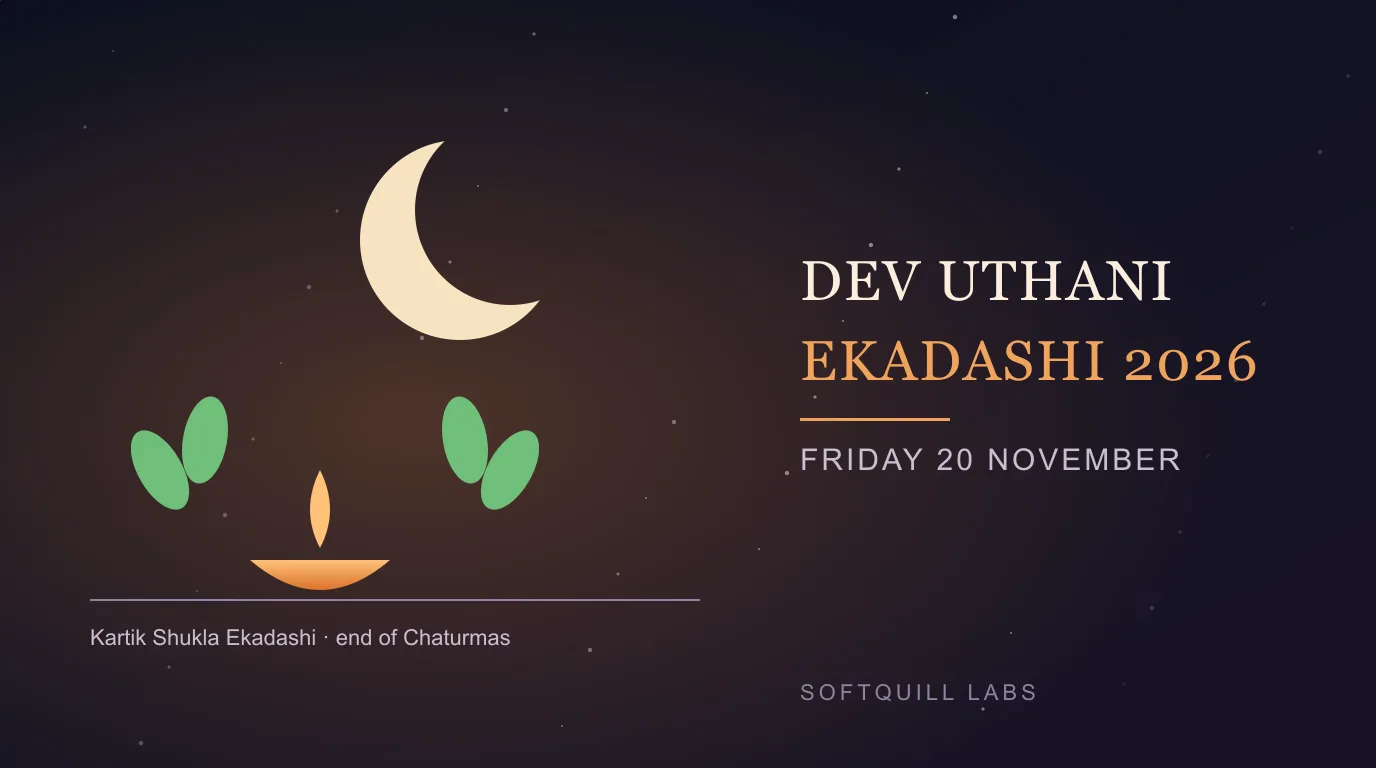
Prabodhini Ekadashi is the Ekadashi of the bright fortnight (Shukla Paksha) of Kartik. It goes by several names: Devutthana or Dev Uthani Ekadashi ("the gods rise"), Prabodhini ("the awakening") and, in Maharashtra, Kartiki Ekadashi. For many families it is one of the most important fasts of the year, second only to Nirjala Ekadashi.
This guide covers the 2026 date, what the day marks, and how it is commonly observed. Traditions differ in the details. Your family's practice, your guru or your local temple's panchang is the final word.
Dev Uthani Ekadashi 2026: the date
| Observance | Date (India) |
|---|---|
| Prabodhini Ekadashi (most panchangs, Smartha) | Friday, 20 November 2026 |
| Vaishnava Ekadashi (some calendars) | Saturday, 21 November 2026 |
| Parana for the 20 November fast | Saturday, 21 November 2026, after sunrise (time depends on city) |
| Tulsi Vivah (widely observed) | Saturday, 21 November 2026 |
Outside India the date can move. A tithi begins at the same instant everywhere, but each place's sunrise falls at a different point in it, so in places such as Singapore and Australia the observance can fall a day later than in India. Always use a panchang calculated for your own city.
Why some calendars show 21 November
When a panchang lists two consecutive days, it is not a mistake. Smartha practice generally observes the day on which Ekadashi is present at sunrise. Vaishnava traditions also require that Dashami, the previous tithi, has fully ended before the pre-dawn period called Arunodaya; if it has not, the fast moves to the next day. We explain both rules in Smartha vs Vaishnava Ekadashi.
What the day marks
According to the Puranic tradition, Lord Vishnu goes into Yoga Nidra, a cosmic sleep, on Devshayani Ekadashi in Ashadha (25 July in 2026). He rests through the four months of the rains, a period called Chaturmas, and wakes on Prabodhini Ekadashi.
Chaturmas is traditionally a time of restraint: many people take on extra vows, avoid certain foods, and postpone weddings, housewarmings and other auspicious ceremonies. Prabodhini Ekadashi closes that period. In many communities the wedding season begins after it, which is why the days that follow are busy in temples and marriage halls.
In Maharashtra, Kartiki Ekadashi is the second great pilgrimage of the year to the Vitthal temple at Pandharpur, after Ashadhi Ekadashi, when Varkari pilgrims walk there to mark the same awakening.
How it is commonly observed
- The fast. The usual Ekadashi rules apply: no grains, rice, wheat, pulses or beans. Some keep a phalahar fast (fruit, milk, nuts, and permitted foods such as sabudana or kuttu), some take water only, and some keep a full nirjala fast. Our guide to Ekadashi fasting rules and foods allowed covers the common options. Anyone with a health condition, pregnant or elderly should choose a lighter form; the tradition itself allows it.
- Waking the Lord. In the evening, many households and temples perform a simple ritual to "wake" Vishnu: conch shells, bells and songs, sugarcane stalks set up as a canopy, and offerings of seasonal produce such as sugarcane, water chestnut (singhara), sweet potato and amla.
- Night vigil. Staying up for kirtan or reading from the Vishnu Purana or the Bhagavata is common, especially in Vaishnava homes.
- Lamps. Diyas are lit at the door and by the tulsi plant, continuing the lamps of the Kartik month.
Tulsi Vivah
Tulsi Vivah is the ceremonial marriage of the tulsi (holy basil) plant to Lord Vishnu, usually in the form of a Shaligram stone or an image of Krishna. The tulsi pot is decorated as a bride, with a red cloth, bangles and a small mandap, and the rites of a wedding are performed.
Families choose different days for it. Many perform it on Dwadashi, the day after Prabodhini Ekadashi (21 November in 2026); others hold it on the Ekadashi evening itself, and some on any day up to Kartik Purnima. Follow your family's custom.
Bhishma Panchaka
Some Vaishnava traditions observe the last five days of Kartik, from Prabodhini Ekadashi to Kartik Purnima, as Bhishma Panchaka, a period of extra austerity named after Bhishma of the Mahabharata. Practice ranges from a simple diet to strict fasting; your tradition sets the rules.
Breaking the fast
The fast is broken on Dwadashi, the next morning, within the Parana window: after sunrise, after Hari Vasara (the first quarter of Dwadashi) has passed, and before Dwadashi ends. The exact window depends on your city's sunrise and on when the tithis change, so it is different in Kolkata and Mumbai even on the same morning. On 21 November 2026, Kolkata's sun rises at about 05:53 and Mumbai's at about 06:49.
Step-by-step rules, including what to eat first, are in our complete Parana guide.
The next Ekadashi after this one is Utpanna Ekadashi on Friday 4 December 2026. Every date for 2026 and 2027 is in our Ekadashi calendar.
Dates in this guide are from widely used Indian panchangs for 2026 and are given for India. Conventions vary by community and region; please confirm with your local temple or family panchang.
References
- Padma Purana, Uttara Khanda — Kartik Mahatmya (on Prabodhini Ekadashi and the Kartik month).