How CIBIL Score is Calculated: Score Ranges (300–900) and Why 750 Matters
CIBIL does not publish its formula, but it does say what goes into the score and roughly how much each part counts. Here is what is known, what each band means, and why a 747 can cost you more than a 750.
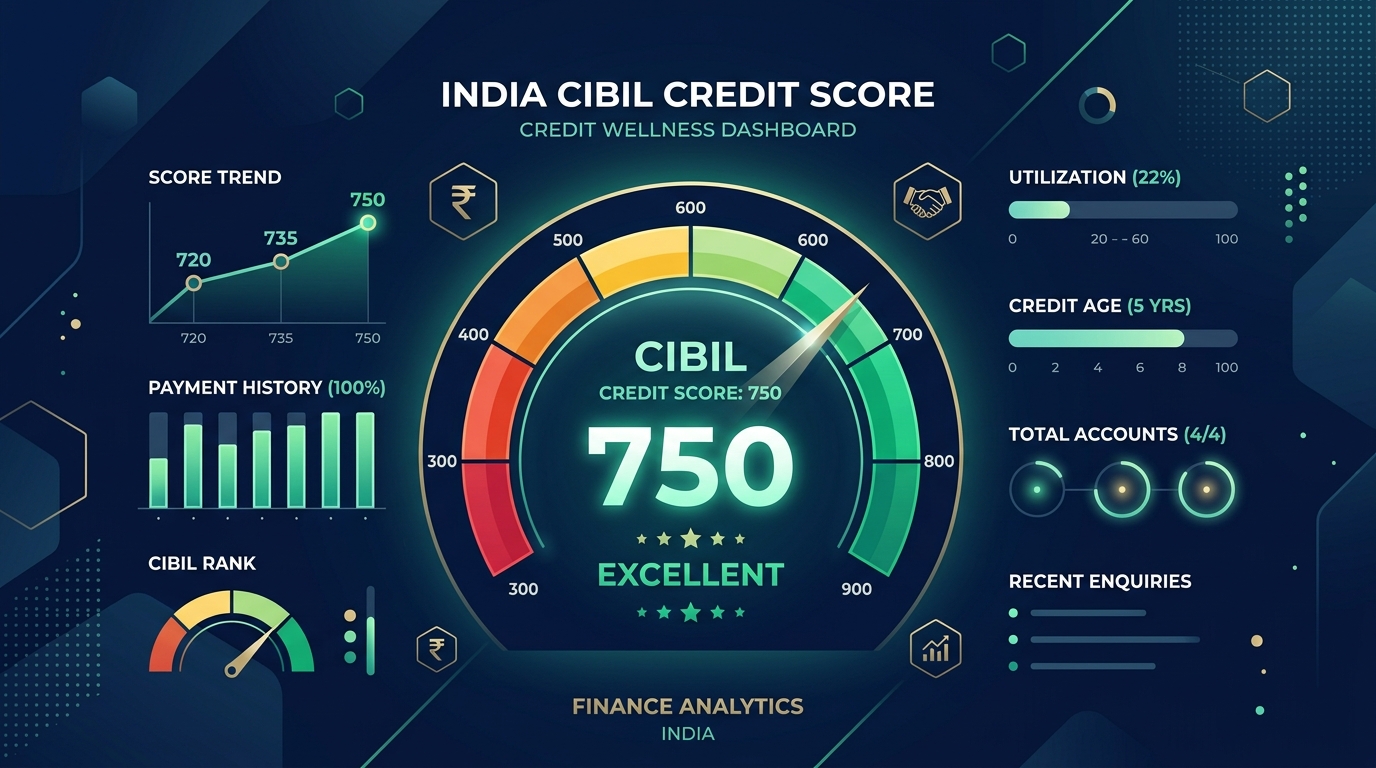
When you apply for a card or a loan in India, the lender pulls your score from TransUnion CIBIL, and often from Experian, CRIF High Mark or Equifax as well. It runs from 300 to 900, and it decides a lot: whether you are approved, and at what rate.
Most people have no idea how it is worked out. Why does one late payment knock off so many points? Why can a 747 be priced differently from a 750?
This guide covers what goes into the score, what the bands mean to a lender, and how the 750 line affects what you pay.
Score ranges and what they mean
Lenders broadly group scores like this, though each sets its own exact cut-offs:
| Score Range | Rating | Loan Approval Likelihood | Impact on Interest Rates |
|---|---|---|---|
| 750 to 900 | Excellent | Very High (>90% approval rate) | Prime interest rates, discounted processing fees, pre-approved offers |
| 700 to 749 | Good | Moderate to High (Approved with standard underwriting) | Standard rack rates; slight interest risk premium (0.20% to 0.50% higher) |
| 650 to 699 | Fair / Average | Low to Moderate (Requires co-applicant or collateral) | Higher interest rates; strict income verification and high scrutiny |
| 550 to 649 | Poor | Very Low (Mainstream bank rejection) | Referred to NBFCs or fintech apps charging 18% to 36% APR |
| 300 to 549 | Critical | Near Zero (Severe default / NPA history) | Flat rejection across all formal lending institutions |
Note: If you have zero credit history or your active accounts have been dormant for years, your credit bureau report may return -1 or NH (No History). This is not a bad score; it simply indicates that you have no credit footprint on file.
The five factors that make up the score
The model itself is confidential, but the factors and their rough weights are widely published:
| Factor | Weight | What It Measures | How to Maximize It |
|---|---|---|---|
| 1. Payment History | ~35% | On-time EMI and credit card payments. Tracked through DPD (Days Past Due). | Never miss a due date. Even a 30-day delay gets flagged and stays on your report for 36 months. |
| 2. Credit Utilization Ratio (CUR) | ~30% | Percentage of total credit card limit utilized on your statement generation date. | Keep your total monthly statement balance under 30% (ideally below 10%) of your sanctioned limit. |
| 3. Credit History Length (Age) | ~15% | Average age of all open credit accounts and the age of your oldest active card. | Keep your oldest credit card active with occasional small recurring subscriptions. Never close your oldest account. |
| 4. Credit Mix | ~10% | Balance between secured credit (home loan, auto loan, gold loan) and unsecured credit (credit cards, personal loans). | Having only unsecured credit cards or instant loans can lower your score; a balanced mix shows multi-product discipline. |
| 5. Recent Credit Enquiries | ~10% | Number of "Hard Inquiries" logged when lenders check your CIBIL report for new credit. | Avoid applying for multiple cards or loans simultaneously. Space out new credit applications by at least 90–180 days. |
Why 750 matters so much
Many Indian banks publish home loan rates that vary by credit score band, so a lower score can mean a higher rate on the same loan.
The line that most often matters is 750:
- 750 and above: usually the bank's lowest published rate.
- Below 750: often a risk premium of around 0.25 to 0.75 percentage points on top.
Consider a ₹50 lakh home loan over a 20-year tenure:
- Borrower A (CIBIL 750+): Sanctioned at 8.40%. Monthly EMI = ₹43,075. Total interest paid = ₹53.38 Lakhs.
- Borrower B (CIBIL 747): Classified in the tier below 750 and charged an 8.65% rate (just 0.25% extra risk spread). Monthly EMI = ₹43,867. Total interest paid = ₹55.28 Lakhs.
Three points cost Borrower B about ₹1,90,000 in extra interest, plus possibly a higher processing fee. If you are at 740 to 749, paying your card down a few days before the statement date is often enough to cross 750 within a month or so.
Utilization: the factor you can change fastest
Credit utilization is commonly put at around 25% to 30% of the score. It is the share of your total card limits that you are using:
$$\text{CUR} = \left(\frac{\text{Total Credit Card Outstanding Balance}}{\text{Total Combined Credit Limit Across All Cards}}\right) \times 100$$
| Combined Credit Limit | Statement Balance | Utilization Ratio | CIBIL Impact |
|---|---|---|---|
| ₹1,00,000 | ₹10,000 | 10% | Best (helps the score most) |
| ₹1,00,000 | ₹28,000 | 28% | Healthy (Within safe threshold, no penalty) |
| ₹1,00,000 | ₹55,000 | 55% | High (Reduces score by 15–30 points over 2 cycles) |
| ₹1,00,000 | ₹92,000 | 92% | Critical (Signals credit hunger; significant drop) |
Timing matters. The balance that gets reported is the one on your statement, not what is left after you pay by the due date. Paying in full every month does not help utilization if the statement shows a high balance. Our statement date guide explains the fix.
Why your CIBIL, Experian and CRIF scores differ
Lenders report to all four credit bureaus licensed in India:
- TransUnion CIBIL: the oldest, and the one most banks check first
- Experian: common with fintech lenders and private banks
- CRIF High Mark: strong in microfinance and small loans
- Equifax: used across retail and commercial lending
Seeing 785 on Experian and 730 on CIBIL is normal. Each bureau has its own model. For home and car loans, most lenders look at CIBIL first.
If you are below 750
You do not need a paid "credit repair" service. The steps are the same ones anyone can take:
- The step-by-step version, by starting score, is in how to increase your CIBIL score from 500 or 600 to 750.
- If card balances are the problem, a plan to pay them down brings utilization under 30% and saves interest at the same time. PayOffPath can model that on your phone.
Changes to this guide
- : Corrected the extra interest a 747 score can cost compared with 750 to about ₹1.9 lakh (the heading said ₹2.8 lakh). Wording made plainer.