Is 650, 700 or 750 a Good CIBIL Score? What Your Number Means
You checked your score and got a number like 662, 727 or 781. This guide shows what that number gets you from an Indian lender, what it costs compared with the next band up, and the one thing to fix first.
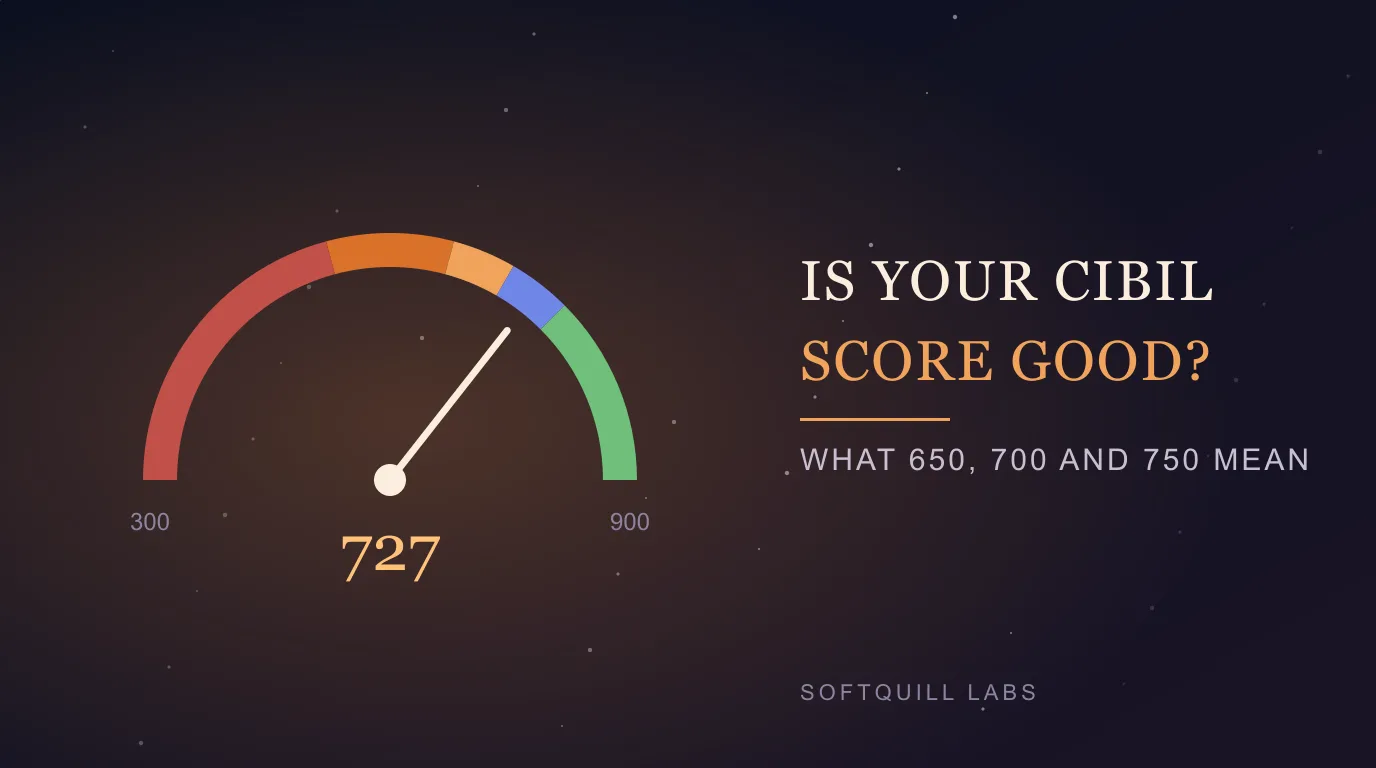
A credit app tells you your CIBIL score is 727. Is that good? The honest answer is that a lender doesn't look at the exact number. It looks at which band you fall in, and every band comes with its own rules: whether you are approved, which products you are offered, and what interest rate you pay.
Find your number below, then read the section for your band. If you want to know how the score itself is built, read how CIBIL score is calculated. To raise it, see how to increase your CIBIL score from 600 to 750+.
Find your score: the quick table
| Your score | How lenders see it | What you can usually get | Fix first |
|---|---|---|---|
| 800 to 900 | Excellent | Best published rates, pre-approved offers, room to negotiate fees | Nothing. Keep paying on time. |
| 750 to 799 | Very good | Easy approval for home, car and personal loans and most cards | Keep card usage low to stay above 750 |
| 700 to 749 | Good | Usually approved, but often at a slightly higher rate than 750+ | Card utilization on your statement date |
| 650 to 699 | Fair | Secured loans and entry-level cards; unsecured loans with more checks | Any late payment in the last 12 months |
| 550 to 649 | Weak | Gold loans, FD-backed cards, some NBFCs at high rates | Overdue or settled accounts on your report |
| 300 to 549 | Poor | Mostly secured credit only | Clear defaults, then rebuild with a secured card |
| -1, NA or NH | No history | Not a bad score; you are simply new to credit | Start with one card and use it lightly |
These bands are how most Indian lenders talk about scores. Each bank sets its own cut-offs, and income, existing EMIs and job stability matter as much as the score.
800 to 900: as good as it gets
A score above 800 puts you in the lowest-risk group. Above about 800 the extra points rarely change your rate; a lender treats 810 and 860 almost the same. You get the bank's best published rate, and you can ask for a lower processing fee or a fee waiver.
Is 900 possible? In theory, yes, but very few people get there, and there is nothing to gain from it. Once you are above 800, keep doing what you are doing.
750 to 799: the score most lenders want
A score from 750 to 799 clears the cut-off that most banks use for their best rate band. Home loans, car loans, personal loans and most mid-tier cards are straightforward to get, subject to income.
The risk here is slipping under 750 by accident. A single month where you use most of your card limit can pull a 760 down into the 740s until the next statement. Pay down the card before the statement date, not just the due date, and you stay above the line.
700 to 749: good, but often a rate step below the best
A score in the low 700s or mid 740s is good. You will usually be approved. What you may lose is price: many banks publish home loan rate cards that step up for scores below 750, and personal loan offers are often a little higher.
Here is what a rate step costs on a ₹30 lakh home loan over 20 years:
| Rate | Monthly EMI | Total interest over 20 years | Extra vs 8.50% |
|---|---|---|---|
| 8.50% | ₹26,035 | ₹32.48 lakh | — |
| 9.00% | ₹26,992 | ₹34.78 lakh | ₹2.30 lakh |
| 9.50% | ₹27,964 | ₹37.11 lakh | ₹4.63 lakh |
Illustrative rates, not one bank's rate card. Check your lender's published rates by score band.
If you are at 740 to 749 and a big loan is coming, it is usually worth waiting one or two billing cycles to cross 750. The fastest lever is utilization. Since January 2025, the RBI requires lenders to report to credit bureaus every fortnight rather than monthly, so a lower card balance can show up on your report within weeks.
650 to 699: fair, with more paperwork
A score in the 650 to 699 range usually means something in your history worries lenders: a late payment, very high card usage, or a short history. You can still borrow, but expect:
- Home and car loans approved with more income checks, and sometimes a higher rate.
- Unsecured personal loans offered at higher rates, or with a lower amount than you asked for.
- Entry-level credit cards, or a card against a fixed deposit.
What a higher personal loan rate costs on ₹5 lakh over 3 years:
| Rate | Monthly EMI | Total interest |
|---|---|---|
| 11% | ₹16,369 | ₹89,297 |
| 14% | ₹17,089 | ₹1,15,197 |
| 18% | ₹18,076 | ₹1,50,743 |
If you need money now, a secured option can be much cheaper than an unsecured loan at this score. See personal loan vs gold loan vs credit card EMI. Going from the 650s to 700+ usually takes 6 to 12 months of clean payments.
Below 650: rebuild before you borrow
A score in the low 600s or the 500s usually means a missed payment, an overdue account, or a loan marked "settled" instead of "closed". Mainstream banks will turn down most unsecured applications. Every rejection adds a hard enquiry, which pulls the score down further.
The order that works:
- Get your full report, not just the score. You can get one free full report a year from each credit bureau. Look for overdue accounts and anything you don't recognise.
- Clear overdues and fix errors. Raise a dispute with the bureau for mistakes; the bureau checks with the lender.
- Stop applying for new credit until the score recovers.
- Rebuild with one secured card against a fixed deposit, used lightly and paid in full.
The month-by-month version is in how to increase CIBIL score from 500 or 600 to 750+.
-1, NA, NH and scores of 1 to 5
Not every result is a number between 300 and 900:
- -1, NA or NH means CIBIL has no usable credit history for you. It isn't a penalty. Many lenders treat new-to-credit applicants differently from low scorers, but you have fewer options.
- A score from 1 to 5 has been used by CIBIL for people with less than six months of history, where 1 is higher risk and 5 is lower. It is a different scale, not a "very low" CIBIL score.
CIBIL score vs a US credit score
If you saw "741 credit score" on a US website, it uses a different scale. A US FICO score runs from 300 to 850, and 740 to 799 counts as "very good" there. The Indian bureaus (CIBIL, Experian, CRIF High Mark, Equifax) each use their own model, so your score can differ by bureau. Most Indian banks look at CIBIL first.
FAQs
Is 750 a good CIBIL score?
Yes. 750 is the cut-off most Indian lenders use for their best rate band. Above it, approval mostly depends on your income and existing EMIs.
Is 700 a good CIBIL score?
It is good enough for most loans and cards, but you may pay a slightly higher rate than someone at 750+. Bringing your card balance down before the statement date is the quickest way to close the gap.
Is 650 a good CIBIL score?
It is fair. Secured loans and entry-level cards are usually possible; unsecured personal loans will cost more or may be refused. Check your report for late payments before applying.
Does checking my own CIBIL score lower it?
No. Checking your own score is a soft enquiry and has no effect. Only lender checks when you apply for credit count as hard enquiries.
What is the maximum CIBIL score?
900. Very few people reach it, and lenders treat any score above about 800 as top tier.
Score bands and rate examples in this guide are general and illustrative. Each lender sets its own criteria and rates; your loan offer and credit report are the final word. This is general information, not financial advice.
Sources
Changes to this guide
- : Wording made plainer and the PayOffPath note updated to the standard text.