No-Cost EMI Explained: What a ₹60,000 Phone Really Costs on 6 Months
The interest on a no-cost EMI is real; the seller just pays it for you. What you still pay is the GST on that interest, a processing fee, and sometimes a discount you gave up without noticing.
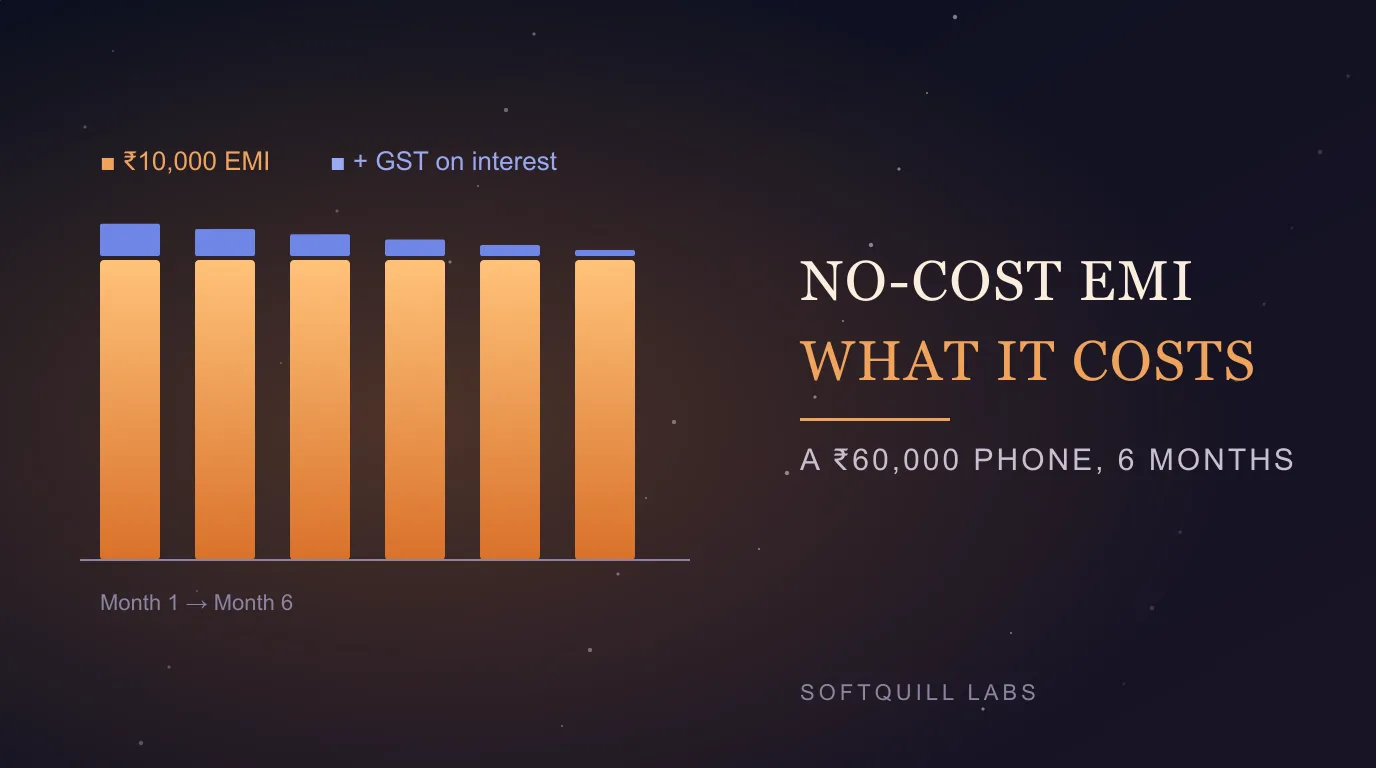
Every festive sale brings the same badge: No-Cost EMI. Split a ₹60,000 phone into six payments of ₹10,000 and pay nothing extra. That is almost true, and the gap between "almost" and "true" is worth understanding before you tap the button.
This guide works through one purchase with every number shown, so you can check the maths on your own card statement.
How a no-cost EMI actually works
Banks do not lend for free. In 2013 the Reserve Bank of India told banks that "the very concept of zero percent interest is non-existent" and objected to schemes that hid the interest inside fees. The schemes that followed are built differently: the bank charges its normal EMI interest, and the seller (or the brand) gives you an upfront discount equal to that interest.
So on a ₹60,000 phone at a typical card EMI rate of 15% a year for 6 months:
- The seller knocks ₹2,539.90 off the price, so the amount converted to EMI is ₹57,460.10.
- The bank charges 15% a year on that reducing balance. The EMI comes to exactly ₹10,000.
- Six EMIs of ₹10,000 add up to ₹60,000, the sticker price. That is the "no cost".
The discount is usually shown as a line on the order summary ("No Cost EMI discount") or applied by the bank later as a credit. Either way, the interest is real. It just cancels out.
What does not cancel: GST on the interest
Interest on a credit card EMI attracts 18% GST, and the discount covers the interest only, not the tax on it. The GST is added to each month's statement on top of the EMI.
| Month | Interest (₹) | Principal (₹) | GST on interest (₹) | You pay (₹) |
|---|---|---|---|---|
| 1 | 718.25 | 9,281.75 | 129.29 | 10,129.29 |
| 2 | 602.23 | 9,397.77 | 108.40 | 10,108.40 |
| 3 | 484.76 | 9,515.24 | 87.26 | 10,087.26 |
| 4 | 365.82 | 9,634.18 | 65.85 | 10,065.85 |
| 5 | 245.39 | 9,754.61 | 44.17 | 10,044.17 |
| 6 | 123.46 | 9,876.54 | 22.22 | 10,022.22 |
| Total | 2,539.90 | 57,460.10 | 457.18 | 60,457.18 |
Add a processing fee. Many banks charge one on EMI conversions, commonly around ₹199 plus 18% GST (₹234.82), though it varies by bank and some waive it during sales.
The real extra cost: ₹457.18 + ₹234.82 = ₹692, about 1.2% of the price. Spread over six months, that works out to roughly 4% a year on the money you effectively borrowed. That is cheap credit, but it is not free.
Longer tenure: more GST, lower rate
Keeping the same ₹60,000 phone, 15% bank rate and ₹234.82 fee:
| Tenure | EMI (₹) | Interest covered by discount (₹) | GST you pay (₹) | Total extra (₹) | Effective yearly cost |
|---|---|---|---|---|---|
| 3 months | 20,000 | 1,469 | 264 | 499 | 5.0% |
| 6 months | 10,000 | 2,540 | 457 | 692 | 4.0% |
| 9 months | 6,667 | 3,584 | 645 | 880 | 3.5% |
| 12 months | 5,000 | 4,603 | 829 | 1,063 | 3.3% |
The rupee cost rises with tenure because there is more interest to tax. The yearly rate falls because the fixed processing fee is spread over more months. On a short tenure the fee dominates. If the fee is waived, the cost is simply 18% GST on the interest, which at a 15% bank rate is about 2.6% a year.
The cost that hides best: the discount you gave up
Sales often offer two deals on the same product: an instant bank discount (say ₹3,000 off for paying in full with a card) or no-cost EMI, but not both. Choosing EMI means paying ₹60,000 over six months instead of ₹57,000 today.
In that case the extra cost is not ₹692 but ₹3,692, and the effective rate jumps to about 22% a year, which is higher than many personal loans. Read the offer terms. "No-cost EMI" and "instant discount" are often listed side by side, and the discount usually applies only to full payment.
Other ways the "no cost" leaks:
- Inflated base price. Some listings carry a higher price on EMI than on a cash or UPI checkout. Compare the final payable amount, not the EMI.
- Pre-closure charges. Closing the EMI early can attract a fee (often a percentage of the outstanding amount), and the discount may be clawed back.
- Returns and cancellations. If you return the product, the EMI may be cancelled but the processing fee and GST already billed are usually not refunded.
- Blocked credit limit. The full ₹57,460 is blocked on your card on day one and frees up only as you repay. This raises your credit utilisation, which can affect your CIBIL score if the card limit is small.
One rule that matters more than all of this
The EMI amount is added to your card's monthly bill. If you pay only the minimum due on that bill, the rest of the balance starts attracting the card's revolving interest, typically 3% to 3.75% a month. One month of that wipes out every saving above. Our guide to the minimum due trap shows how quickly it compounds. Treat each EMI as a bill you pay in full.
When no-cost EMI is a good deal
- You would have paid the same price in full anyway, no bigger cash discount exists, and the processing fee is small or waived. Then you pay about 1% extra to keep cash in your account for six months.
- The cash stays in an emergency fund or a liquid investment. The ₹60,000 left in a savings account or a liquid fund for an average of three months earns back part of the GST cost. It does not make you rich, but it keeps your emergency fund intact.
- You are certain of every EMI. If any month is uncertain, the risk of revolving interest is a far larger cost than the GST.
It is a poor deal when it costs you an instant discount, when the product would otherwise not be affordable (EMI makes a ₹60,000 phone feel like ₹10,000), or when you already carry a balance on the card.
How to check any offer in two minutes
- Note the lowest price you could pay in full today, after every cash, UPI or card discount.
- Add up what EMI costs: the EMIs, plus about 18% of the interest as GST, plus the processing fee with GST.
- Compare the two. If the difference is a few hundred rupees and you value the cash flow, EMI is fine. If it runs into thousands, pay upfront.
Or let our free no-cost EMI calculator do it. Enter the price, tenure, fee and any discount you would give up, and it shows the real cost and the month-by-month statement.
Assumptions in this guide: 15% a year bank EMI rate on a reducing balance, 18% GST on interest and fees, a ₹199 processing fee. Your bank's rate, fee and billing may differ; the offer's terms and your card statement are the final word. This is general information, not financial advice.