Rent vs Buy a Flat in India: The Break-Even Maths Over 15 Years
Instead of asking whether buying is 'better', ask what has to be true for it to win. For an ₹80 lakh flat, the answer is a specific annual price growth, and it depends on what you do with the money you did not spend.
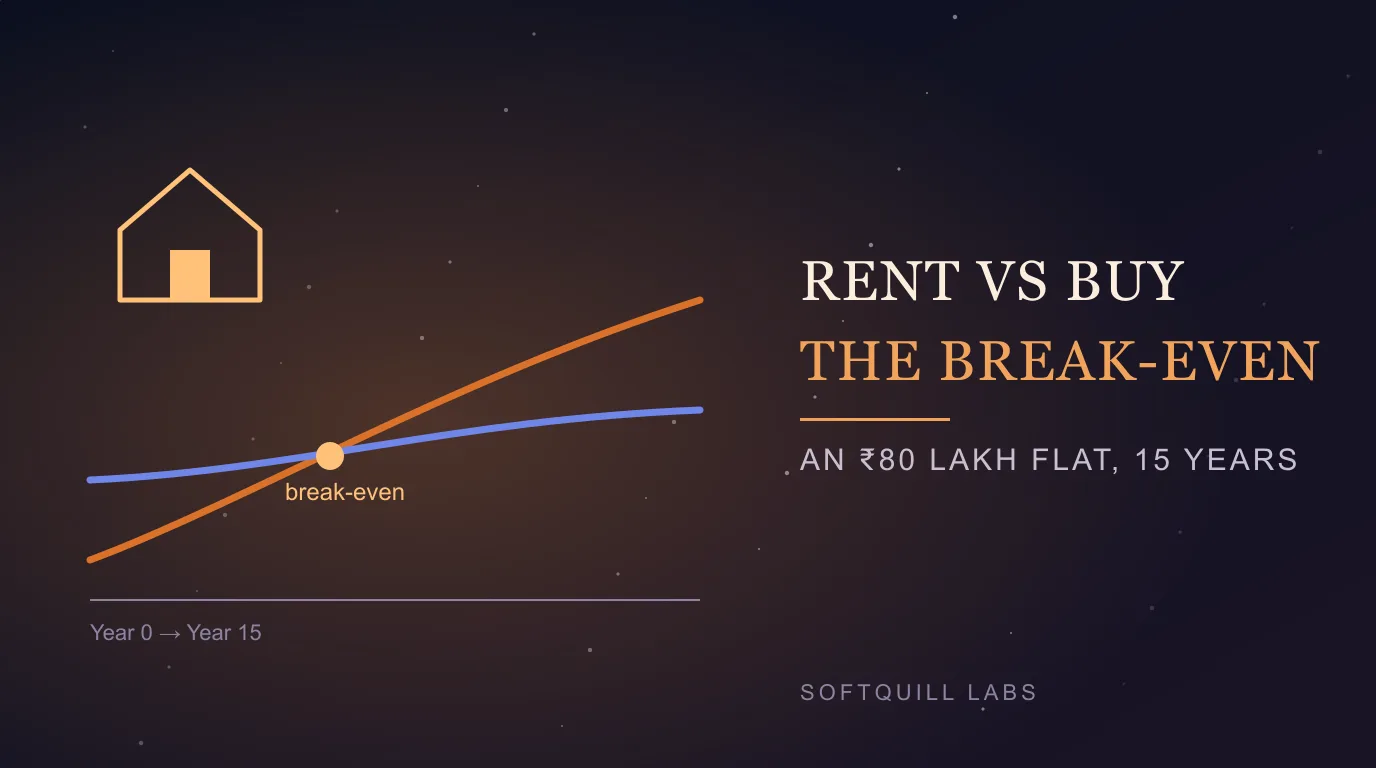
"Rent is dead money" and "property is a bad investment" are both repeated confidently, and both are incomplete. The honest answer depends on three numbers: how fast the flat's price grows, what return you earn on money you invest instead, and how large the rent is compared with the price.
This guide builds a simple model with every assumption printed. It is a way to think, not a prediction.
The setup
- Flat price: ₹80,00,000.
- Buying: 20% down payment (₹16,00,000), a ₹64,00,000 loan at 8.5% for 20 years. The EMI is ₹55,541.
- Renting: the same flat rents for ₹25,000 a month (a 3.75% gross yield), rising 5% a year.
- Renter's strategy: invests the ₹16 lakh down payment on day one, and each month invests the difference between the buyer's EMI and the rent.
- Horizon: 15 years, at which point we compare the buyer's equity (price minus remaining loan) with the renter's investment corpus.
After 15 years the buyer's remaining loan balance is about ₹27.1 lakh.
Results after 15 years
| Scenario | Buyer's equity | Renter's corpus | Winner |
|---|---|---|---|
| Price grows 3%, investments earn 8% | ₹97.6 lakh | ₹129.3 lakh | Renting |
| Price grows 5%, investments earn 8% | ₹139.2 lakh | ₹129.3 lakh | Buying |
| Price grows 7%, investments earn 8% | ₹193.7 lakh | ₹129.3 lakh | Buying |
| Price grows 5%, investments earn 10% | ₹139.2 lakh | ₹165.1 lakh | Renting |
| Price grows 7%, investments earn 10% | ₹193.7 lakh | ₹165.1 lakh | Buying |
Assumptions: monthly compounding of the renter's investments; no taxes on gains or rental income; no stamp duty, registration, brokerage, maintenance, property tax or home-loan tax deductions on either side; EMI and rent paid on time; rent growth 5% a year.
The break-even
Solving for the price growth at which buyer and renter finish level:
- If investments earn 8%, the flat must appreciate about 4.6% a year for buying to win.
- If investments earn 10%, the flat must appreciate about 6.0% a year.
This is the useful insight: buying is not a bet on the flat alone. It is a bet that the flat will grow faster than the alternative use of the same money. A loan at 8.5% is also a fixed hurdle: you pay that rate on the borrowed ₹64 lakh whatever happens to the price.
What the model leaves out
These omissions do not all point the same way, so treat the break-even as a rough guide rather than an answer.
- Costs that favour renting: stamp duty and registration (a few percent of the price, varying by state), brokerage, maintenance, society charges, property tax and repairs. All of these raise the break-even growth for the buyer.
- Benefits that favour buying: any tax deduction on home-loan interest and principal you are eligible for under the rules applicable to you, which reduce the effective cost of the loan. Rules and regimes change, so verify the current position with a tax professional.
- Taxes on the renter's gains reduce the renter's corpus, and tax on the buyer's capital gains at sale reduces the buyer's equity.
- Discipline. The model assumes the renter really invests the difference every month. In practice, an EMI is a forced saving, and many renters do not invest the gap. This is a human factor, not a mathematical one, but it matters.
- Non-financial value. Security of tenure, freedom to modify the home and living where you want have value that no table captures. Equally, the freedom to move cities for work does too.
How to use this for your own decision
- Get your rent-to-price ratio. Annual rent divided by the price. In this example it is 3.75%. The lower it is, the harder buying is to justify on numbers alone.
- Be conservative about growth. Check the actual price history of your own micro-market rather than assuming a national figure.
- Be realistic about your alternative. A 10% investment return is not guaranteed and carries risk, while the loan interest is certain. If you would not invest the difference, the comparison shifts toward buying.
- Stress-test the EMI. Check that the EMI is comfortable with a higher rate (see our guide to rate resets) and keep an emergency fund after paying the down payment.
- Understand the loan first. Our EMI formula guide shows why early payments are mostly interest.