Home Loan Rate Went Up: Should You Raise the EMI or Extend the Tenure?
A 0.5% rate rise sounds small. Whether it lands on your EMI or on your tenure changes what it costs you by several lakhs.
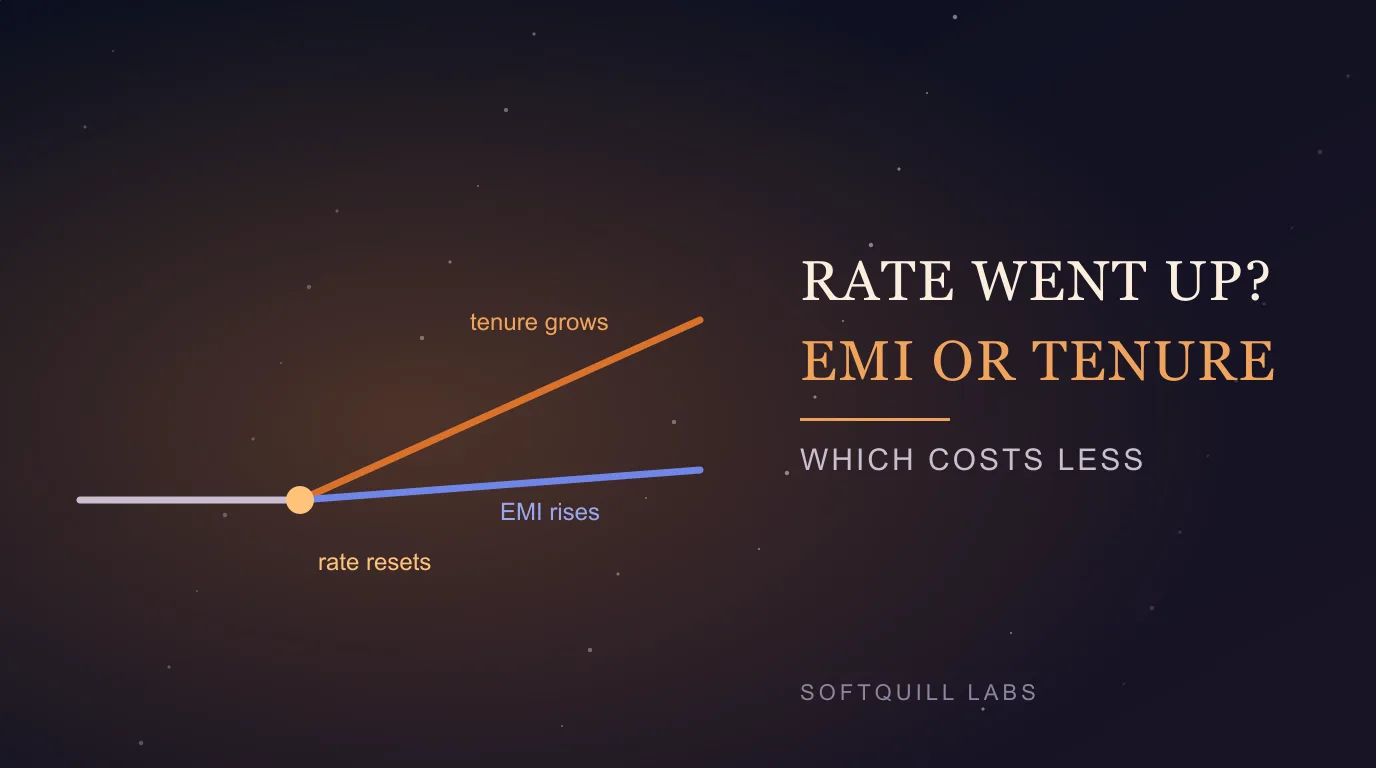
Most new home loans in India are floating-rate loans linked to an external benchmark such as the RBI repo rate. When the benchmark moves, your rate moves with it at the next reset. Lenders then have to absorb the change somewhere: in a higher EMI, in a longer tenure, or a mix of both.
The choice looks like a matter of convenience. It is not. The two routes cost very different amounts, and this guide quantifies it with one worked example.
A short background on resets
Since the RBI moved retail floating-rate loans to external benchmarks, the lender's spread over the benchmark is fixed for the loan unless your credit profile changes, and the rate resets at defined intervals. The details, including your reset period, are in your sanction letter and loan agreement. More recent RBI guidance on resets of EMI-based floating-rate loans also expects lenders to tell you when a reset changes your EMI or tenure and to offer options such as part-prepayment or switching to a fixed rate. Read the current circulars on the RBI website and your own agreement rather than relying on a summary, including this one, because the rules and your lender's implementation can change.
The setup
- Loan: ₹40,00,000 at 8.5% for 20 years. EMI: ₹34,713.
- After 12 EMIs the outstanding balance is ₹39,20,391 and 228 months remain.
- The rate then resets to 9.0% and stays there for the rest of the loan (a simplification, since real rates keep moving).
Three paths compared
| Path | EMI | Months remaining | Total still to pay |
|---|---|---|---|
| Rate stays at 8.5% (reference) | ₹34,713 | 228 | ₹79.1 lakh |
| A. Rate rises, raise EMI, same end date | ₹35,946 | 228 | ₹82.0 lakh |
| B. Rate rises, keep EMI, tenure grows | ₹34,713 | about 251 | ₹87.2 lakh |
Assumptions: balance after 12 months of ₹39,20,391 from a month-by-month model; 9.0% applied for the remaining term; all payments on time; no prepayments, fees or rounding adjustments.
Reading the table
- Path A costs you ₹1,233 more every month, about ₹2.8 lakh more than the unchanged-rate path over the remaining 19 years.
- Path B feels free because the monthly outgo never changes. But it adds about 23 months (almost two years) to the loan and costs roughly ₹8.1 lakh more than the reference, nearly three times Path A.
The reason is simple: when the EMI does not rise, the extra interest each month eats into the principal repayment. The balance falls more slowly, so interest keeps accruing on a larger amount for longer. A lower EMI relative to the interest due is the same effect as the early years of any loan, only now it persists.
What to do about it
- Check which option your lender defaults to. If your tenure is quietly extending after each rate rise, you will see it in your latest loan statement as a higher end date, not as a bigger EMI.
- If your budget allows, raise the EMI to protect the original end date. Even partly raising it limits the tenure creep.
- Use a lump sum. A one-time part-prepayment after a rate rise cuts the balance directly. See our prepayment guide for how much a single extra EMI a year can save.
- Ask about the other options. Lenders may offer to switch to a fixed rate for a period or to reset the spread, usually for a fee. Compare the fee and rate with the savings from the calculations above before agreeing.
- Compare with a balance transfer only after counting processing fees, legal charges and any prepayment terms on the new loan.
Limits of this example
The model holds the new rate constant, but real benchmark rates can rise and fall, so the real outcome will differ. The direction of the result does not depend on that, though: absorbing a higher rate through a longer tenure costs more than absorbing it through a higher EMI, because the principal is repaid more slowly.
Sources
Changes to this guide
- : Wording made plainer and the PayOffPath note updated to the standard text. No figures changed.