Home Loan EMI Formula Explained: A Worked ₹40 Lakh Example
Your bank gives you one EMI number. This guide shows where it comes from, why most of the early payments are interest, and how a half-point change in rate moves the total by lakhs.
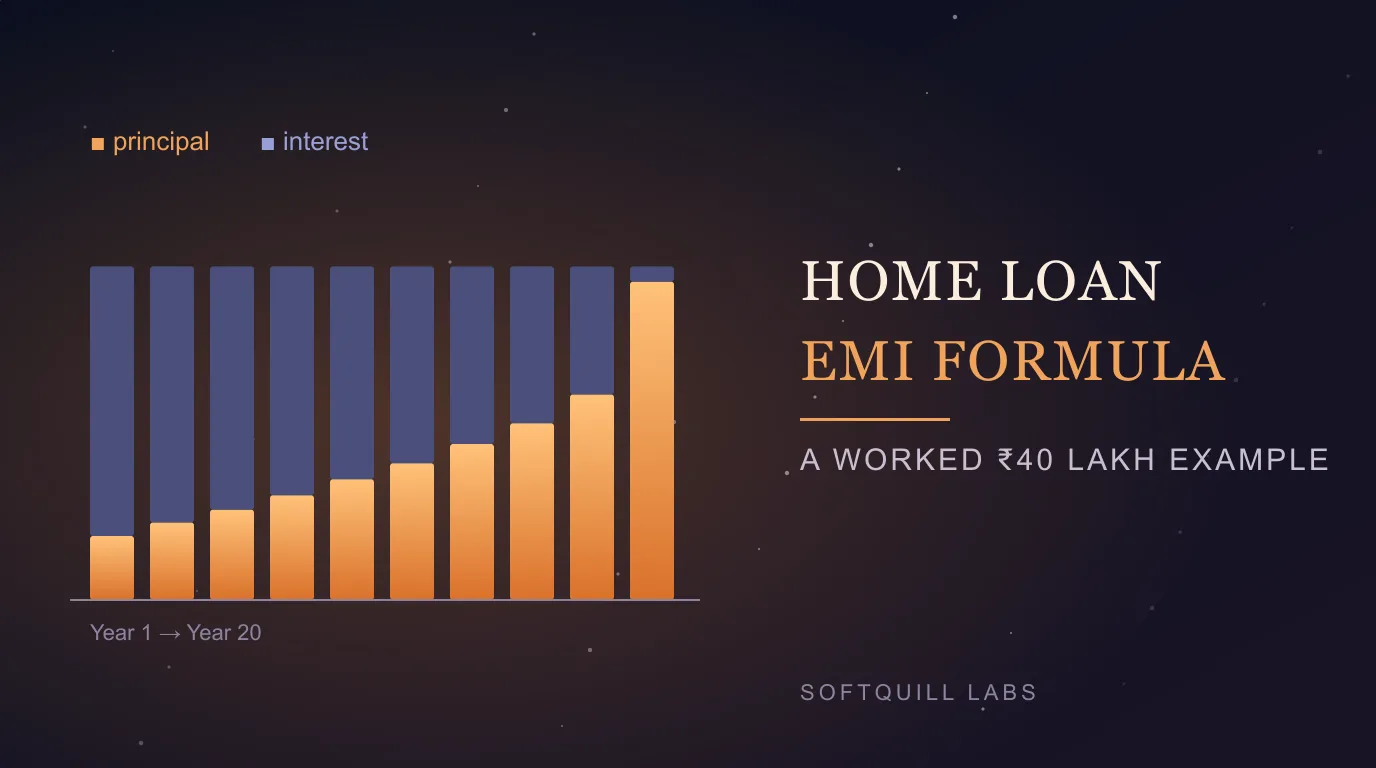
Every home loan sanction letter has one number that matters in daily life: the EMI. Most borrowers accept it without knowing how it was produced. That is a pity, because the formula is short, and once you understand it, loan offers, prepayment decisions and rate changes all become easier to judge.
This guide works one example by hand and then checks it against a month-by-month schedule. Every figure below comes from that schedule, and the assumptions are printed so you can reproduce them.
The EMI formula
For a reducing-balance loan, which is how Indian home loans are structured, the EMI is:
EMI = P × i × (1 + i)n ÷ ((1 + i)n − 1)
- P is the loan amount (principal).
- i is the monthly interest rate: the annual rate divided by 12, then by 100.
- n is the number of monthly instalments.
The formula finds the one fixed payment that, when applied month after month, brings the balance to exactly zero on the last instalment.
A worked example: ₹40 lakh, 8.5%, 20 years
Take a loan of ₹40,00,000 at 8.5% a year for 20 years.
- P = 40,00,000
- i = 8.5 ÷ 12 ÷ 100 = 0.0070833
- n = 20 × 12 = 240
(1 + i)240 works out to about 5.4412. Substituting:
EMI = 40,00,000 × 0.0070833 × 5.4412 ÷ (5.4412 − 1) = ₹34,713 (rounded to the nearest rupee).
Over 240 payments you repay about ₹83.3 lakh. Of that, ₹40 lakh is the amount you borrowed and about ₹43.3 lakh is interest. On this loan, interest is more than the principal.
What your first EMI is actually paying
Interest each month is charged on the outstanding balance, so you can split any EMI into two parts yourself.
- Month 1 interest = 40,00,000 × 0.0070833 = ₹28,333
- Month 1 principal = 34,713 − 28,333 = ₹6,380
So in your very first payment, about 82% goes to interest and only 18% reduces what you owe. The balance falls by ₹6,380, which makes next month's interest very slightly lower, and the principal share creeps up. This is the whole mechanism of amortization.
How the split changes over 20 years
| Year | Interest paid in year | Principal repaid in year | Balance at year end |
|---|---|---|---|
| 1 | ₹3,36,946 | ₹79,609 | ₹39,20,391 |
| 5 | ₹3,04,842 | ₹1,11,713 | ₹35,25,087 |
| 10 | ₹2,45,936 | ₹1,70,619 | ₹27,99,753 |
| 15 | ₹1,55,969 | ₹2,60,586 | ₹16,91,949 |
| 20 | ₹18,561 | ₹3,97,994 | ₹0 |
Assumptions: ₹40,00,000 principal, 8.5% fixed for the whole term, 240 monthly instalments paid on time, no prepayments, EMI unrounded in the model. A real bank schedule can differ by a few rupees because of rounding and the date on which interest is charged.
Two things stand out:
- In year 1, about 81% of what you pay (₹3.37 lakh of ₹4.17 lakh) is interest.
- After 10 years, which is half the time, you still owe ₹28.0 lakh, or 70% of the original loan. People are often surprised that a half-way loan is nowhere near half-repaid.
This is also why prepayments made early in the loan are so powerful: each rupee you prepay in year 2 removes interest for 18 more years. We cover the effect in detail in How to Prepay Your Home Loan in India.
How much a rate change matters
The same ₹40 lakh over 20 years at different rates:
| Annual rate | EMI | Total interest over 20 years |
|---|---|---|
| 7.5% | ₹32,224 | ₹37.3 lakh |
| 8.5% | ₹34,713 | ₹43.3 lakh |
| 9.5% | ₹37,285 | ₹49.5 lakh |
Each one-point change in the rate moves the EMI by roughly ₹2,500 and the lifetime interest by about ₹6 lakh. A rate difference that looks trivial on a brochure is worth negotiating, or worth a balance transfer if your existing lender is far above the market.
Practical checks before you sign
- Ask for the amortization schedule and compare the month-1 interest with the quick calculation above (balance × annual rate ÷ 12). If they differ a lot, ask why.
- Check processing fees and insurance bundled into the loan. If these are added to the principal, you pay interest on them too.
- Remember pre-EMI interest on staged disbursements for under-construction property. It is charged on the amount disbursed so far, and it is separate from the EMI above.
- Treat the tenure as a choice. Shortening the term from 20 to 15 years raises the EMI but cuts total interest sharply, so choose the shortest tenure your budget can carry comfortably.
Sources
Changes to this guide
- : Wording made plainer and the PayOffPath note updated to the standard text. No figures changed.