Flat Rate vs Reducing Balance: Why a 'Flat 6%' Car Loan Costs About 11%
A flat rate charges interest on the full loan for the whole tenure, even as you repay it. That one detail roughly doubles the true rate. Here is how to convert any flat offer into a number you can compare.
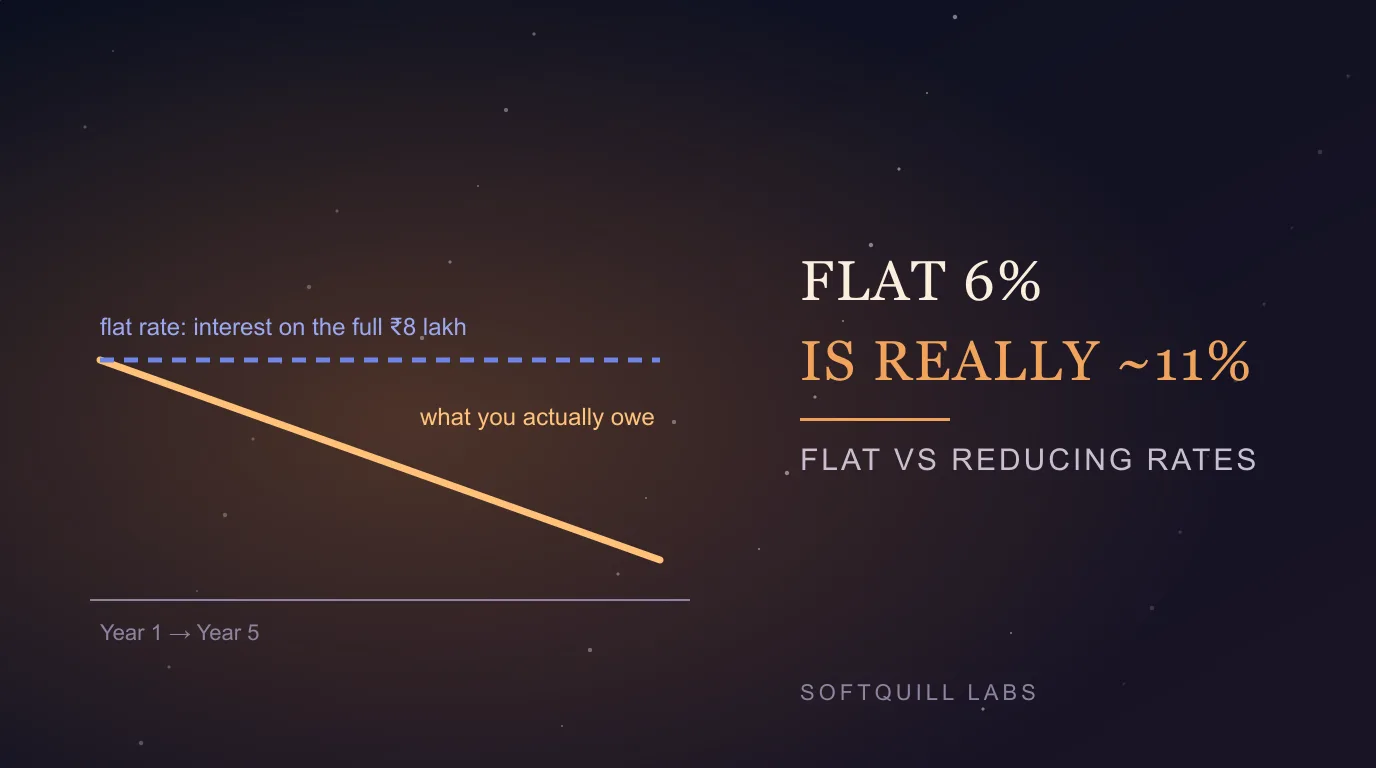
Car showrooms, two-wheeler dealers and some consumer lenders quote loans as a "flat rate": 6% flat, 5 years. Next to a bank's 9.5% car loan, 6% looks like the obvious winner. It is not. The two numbers measure different things, and the flat one is the more expensive loan.
This guide shows why, with a ₹8 lakh car loan worked through to the rupee.
Two ways to charge interest
Reducing balance (what banks quote for home and most car loans): each month, interest is charged only on the amount you still owe. As you repay, the balance falls and so does the interest. The standard EMI formula is built on this.
Flat rate: interest is calculated on the original loan amount for the entire tenure, as if you never repaid a rupee of it:
Total interest = Loan × Flat rate × Years
EMI            = (Loan + Total interest) ÷ Months
By the last year you may owe only a fraction of the loan, but you are still paying interest as if you owed all of it.
Worked example: ₹8 lakh at 6% flat for 5 years
- Total interest: ₹8,00,000 × 6% × 5 = ₹2,40,000
- EMI: (₹8,00,000 + ₹2,40,000) ÷ 60 = ₹17,333
Now ask: what reducing-balance rate gives the same ₹17,333 EMI on ₹8 lakh over 60 months? Solving the EMI formula backwards gives 10.85% a year. That is the rate you are really paying.
Compare it with a bank offer at 9.5% reducing:
| ₹8 lakh, 5 years | EMI (₹) | Total interest (₹) | True yearly rate |
|---|---|---|---|
| Dealer: 6% flat | 17,333 | 2,40,000 | 10.85% |
| Bank: 9.5% reducing | 16,801 | 2,08,089 | 9.50% |
| Difference | 532 a month | 31,911 |
The "6%" loan costs about ₹32,000 more. And if it really were 6% on a reducing balance, the total interest would be only ₹1,27,974, about half of what the flat loan charges.
Conversion table: flat rate to true rate
The true rate depends on the tenure, not on the loan amount, so this table works for any loan size:
| Flat rate | 3 years | 5 years | 7 years |
|---|---|---|---|
| 5% flat | 9.31% | 9.15% | 8.97% |
| 6% flat | 11.08% | 10.85% | 10.58% |
| 7% flat | 12.83% | 12.50% | 12.16% |
| 8% flat | 14.55% | 14.13% | 13.69% |
A handy rule of thumb: the true rate is a little under double the flat rate (about 1.7 to 1.9 times for these rates and tenures). If a flat quote is more than half the bank's reducing rate, the bank is probably cheaper.
For any other rate or tenure, use our free flat to reducing rate converter. It also compares the flat offer with a bank offer in rupees.
Why it comes out nearly double
On an evenly repaid loan, your average balance over the tenure is roughly half the original amount. A reducing-balance loan charges interest on that shrinking balance; a flat loan charges it on the full amount every month. Paying interest on twice the money you owe, on average, is close to paying twice the rate. It is not exactly double because, with a reducing-balance EMI, early payments are mostly interest, so the balance falls slowly at first.
The trap gets worse if you prepay
Suppose you want to close the flat-rate loan after 24 EMIs. A naive split says you have repaid 24/60 of the principal, so you owe ₹4.8 lakh. Lenders do not usually calculate it that way. Most work out the outstanding amount using the loan's effective rate (or an older method called the Rule of 78), which front-loads the interest. At the 10.85% effective rate, the outstanding principal after 24 EMIs is about ₹5.31 lakh, roughly ₹51,000 more than the naive figure, before any foreclosure charge.
Ask for the foreclosure statement method in writing before signing. If you expect to pay extra or close early, a reducing-balance loan with low or no prepayment charges is almost always better.
How to compare any two loan offers
- Ask for the APR or "effective annual rate". The RBI requires lenders to give a Key Fact Statement for retail loans, which shows the annual percentage rate including fees. Compare APRs, not headline rates.
- Compare the EMI and the total you will pay for the same amount and tenure. The lower total wins, whatever the rate is called.
- Add the fees. Processing fees, documentation charges and mandatory insurance bundled into the loan all raise the true cost. A "0% processing fee" on a flat loan is still a flat loan.
- Check prepayment and foreclosure terms, as above.
When dealer finance is still worth it
Dealer schemes sometimes come with real benefits: a cash discount, free accessories or insurance, or a manufacturer subsidy that genuinely lowers the rate. Value those in rupees and subtract them from the flat loan's total cost before comparing. If the dealer's total, after benefits, is still higher than a bank loan's, take the benefits on a cash purchase funded by the bank loan, if the dealer allows it.
Assumptions: monthly EMIs, no fees, no insurance, interest computed monthly on the reducing balance at the stated rates. Your lender's terms are the final word. This is general information, not financial advice.